









Injured by a Utility or Service Truck in Odessa? Read This First
If a bucket truck, electric company vehicle, telecom service rig, or city maintenance truck hit you on an Odessa street or a West Texas highway, you are dealing with a case that operates under different rules than a standard car accident. Utility trucks are subject to distinct state and federal regulations, such as FMCSA rules and TxDOT guidelines. Multiple liable parties might include the truck driver, private contractors, or government entities, each with separate insurance policies and legal defenses. Understanding who owned and operated that vehicle determines everything about how your personal injury claim proceeds.
Midland Truck Accident Attorney, led by Erik Garza, focuses exclusively on truck accident cases and commercial vehicle accident claims, including utility service truck crashes across Odessa, Midland, and the Permian Basin. Evidence from the truck’s black box, GPS system, and driver logs can disappear within 72 hours after an accident. Texas has a two-year statute of limitations for truck accident claims, and when a government entity owns the truck, the notice deadline can be as short as six months. Every day without legal representation is a day that data gets overwritten and deadlines move closer.
Call (713)677-0423 for a free consultation, available 24/7/365. There is $0 upfront and no fees unless we recover compensation for you.
Why Odessa Utility Truck Victims Turn to Midland Truck Accident Attorney
Utility and service truck crashes in Odessa and across the Permian Basin involve layers of complexity that standard car accident attorneys rarely encounter: governmental immunity questions, commercial insurance policies with coverage starting at $750,000, oilfield contractor chains, and electronic evidence that requires immediate preservation. These commercial cases demand a law firm built around trucking law and local oilfield operations.
Concrete Trust Signals You Can Verify
- $20 million+ recovered for truck crash victims across the Permian Basin (past results do not guarantee future outcomes).
- 30+ years of combined legal team experience; Erik Garza has spent 12+ years fighting trucking and oilfield companies after crashes.
- 100% of the firm’s caseload involves commercial truck and utility/service vehicle accidents. No general personal injury docket.
- Recognized by the National Trial Lawyers and Super Lawyers, with a 99% case success rate.
- $0 upfront cost, contingency fee basis only, plus a $1,000 Texas Performance GUARANTEE.
- Bilingual legal representation in English and Spanish. Se Habla Español.
Why Our Firm Is Different for Odessa Utility & Service Truck Crashes
Utility vehicle accidents often involve unique complications compared to standard passenger car crashes, and one procedural misstep, such as missing a six-month government notice deadline, can eliminate a claim worth six or seven figures. Here is what sets our approach apart:
- Oilfield and energy-company insider knowledge. Erik Garza worked inside ExxonMobil and Noble Energy legal teams before founding this firm. That experience exposed how utilities and contractors structure contracts, shift liability to subcontractors, and control post-crash narratives. We use that knowledge to dismantle those defenses.
- Same-day evidence preservation. We send spoliation letters within 24 hours of engagement, demanding that utility companies, city departments, and telematics vendors preserve GPS routes, crew dispatch logs, bucket-truck maintenance records, and electronic control module data. Evidence in truck accident cases must be preserved within 72 hours; we do not wait.
- Local West Texas focus. We know Odessa city fleet operations, the private utility contractors working Ector and Midland Counties, and the crash patterns along I-20, Highway 191, and Loop 338. Accidents involving commercial and service fleets require familiarity with local court systems, and we practice in these courtrooms regularly.
- Trial-ready on every file. Every case is prepared as though it will go before an Ector County jury or a Midland County jury. Corporate insurers who see a firm willing to try a case offer materially different settlement numbers than those who see a firm that always settles.
- 24/7 direct access. Injured oilfield workers and families can reach us for emergency consults from hospital rooms in Odessa and Midland, any day of the year.
What Counts as a Utility or Service Truck Accident in Odessa?
Many car accident victims do not realize the vehicle that hit them qualifies as a “utility” or “service” truck. That classification matters because it can unlock commercial insurance coverage, government liability waivers, and regulatory violations that would not apply in a standard car crash. A utility truck may be owned by various entities; a private utility company, a subcontractor, a municipal department, or a co-op, and each ownership structure affects the legal process and available remedies.
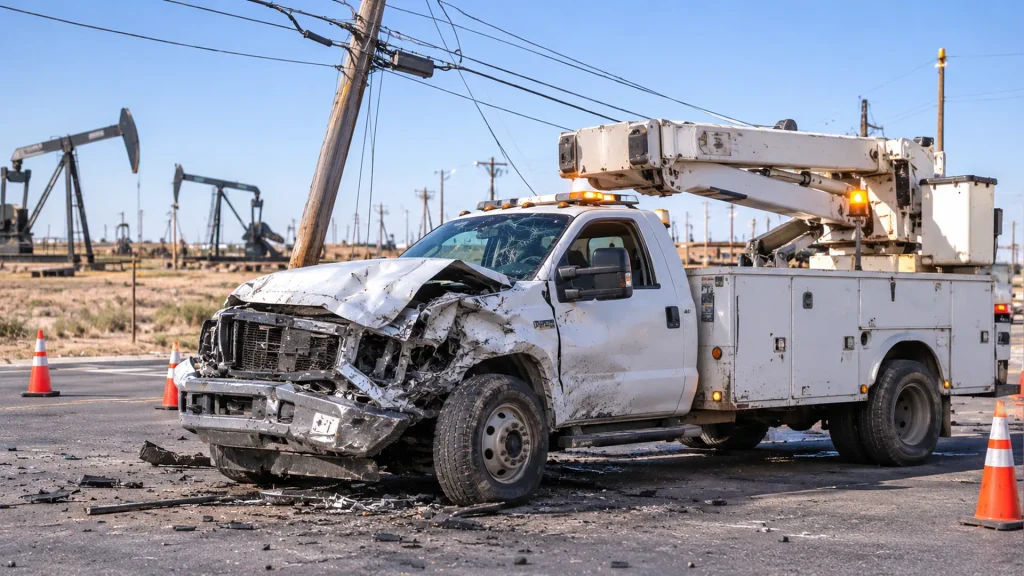
Common Utility and Service Vehicles in the Odessa Area
- Bucket trucks used by electric companies and sign crews along I-20, Highway 191, and Odessa city streets. These vehicles weigh 10,000 to 30,000+ pounds with extended booms and require specialized training to operate safely.
- Line-maintenance trucks for power, cable, and fiber-optic networks operating in Odessa neighborhoods and rural Ector/Midland County rights-of-way.
- Water, sewer, and sanitation service trucks owned by municipalities and private contractors, often making frequent stops in residential areas.
- Natural gas and pipeline maintenance pickups and service rigs traveling FM 866, SH-302, and lease roads into the Permian Basin. These oilfield trucks often carry hazardous materials.
- Traffic signal, street-light, and road-crew vehicles working overnight or in low-visibility conditions, where improper lighting or signage creates collision risks for passenger vehicles.
Crashes involving these commercial vehicles trigger different rules than a standard car accident. Governmental immunity issues may apply to city-owned trucks. Commercial insurance layers start at $750,000 in liability coverage for commercial truckers. And FMCSA rules govern certain vehicles based on weight, cargo, or interstate use.
Where Utility Service Truck Crashes Happen Around Odessa
- Urban intersections where crews work on traffic lights and overhead lines, such as along 42nd Street and Grandview Avenue. Bucket trucks blocking lanes during repairs create blind spots for other drivers.
- High-speed corridors like I-20 and Highway 285 where boom or bucket trucks enter and exit narrow shoulders. TxDOT crash data shows three intersections along SH-191 alone accounted for over 200 reported crashes: SH-191 & US-385 (78), SH-191 & Loop 338 (70), and SH-191 & SS 588 (57).
- Oilfield access roads and county roads connecting Odessa to Andrews, Stanton, Crane, and Big Spring, where utility trucks travel before dawn and after dark on often unlit and unpaved surfaces.
- Residential neighborhoods where large service trucks reverse, park at angles, or partially block lanes during repairs, creating hazards for pedestrians and other vehicles.
Common Causes of Odessa Utility & Service Truck Accidents
Most of these collisions trace back to unsafe company practices, not unavoidable circumstances. Identifying the root cause is how an experienced lawyer establishes liability and connects the driver’s negligence or the company’s failures to compensation.
Driver Fatigue and Overscheduling
Utility and oilfield support crews in the Permian Basin routinely work 15 to 20-hour shifts to restore power after storms or meet drilling timelines. Driver fatigue is a common cause of truck accidents; fatigued drivers experience reaction-time delays comparable to alcohol impairment. The result on roads like I-20 and Highway 285 is lane departures, rear end collisions, and rollovers.
Time sheets, dispatch logs, and hours-of-service records reveal whether the truck driver exceeded safe driving limits. Federal regulations require commercial motor carriers to maintain driver logs for at least six months. We move to secure these records before they are overwritten or “lost.”
Distracted Driving
Distracted driving has increased truck accident rates across the industry. Utility truck drivers face distractions beyond cell phones: onboard tablets displaying digital work orders, dispatch radios, and GPS routing systems mounted on dashboards. The crash patterns are predictable; sudden stops near work zones, sideswipes when merging from shoulders, and striking pedestrians or road workers.
Phone records, truck telemetry, and cab-camera footage can prove that the other driver was looking at a screen instead of the road. Commercial and service trucks often feature telematics, GPS tracking, and electronic logging that capture driver behavior second by second.
Improper Parking and Work-Zone Setups
A bucket truck parked in an active traffic lane without proper cones, advance warning signs, or arrow boards violates Manual on Uniform Traffic Control Devices (MUTCD) standards. These violations constitute negligence per se under Texas law, which recognizes negligence per se for safety statute violations. Odessa streets and rural highways both see crashes caused by utility crews that skip required work-zone protocols.
We use scene photos, body-cam footage, police reports, and TxDOT records to document unsafe setups and establish liability against the contractor or municipality responsible.
Equipment Failures and Poor Maintenance
Improper truck maintenance often leads to tire blowouts, and worn brakes, defective hydraulic systems, and steering failures on aging fleet trucks cause crashes that the company could have prevented with proper maintenance. Defective vehicle components can cause catastrophic truck accidents involving underride collisions or rollover events.
We review maintenance logs, DVIRs (driver vehicle inspection reports), and inspection records to show whether the utility company followed manufacturer maintenance schedules or ignored known defects.
Untrained or Under-Supervised Drivers
Some Odessa-area utilities and contractors put heavy service trucks in the hands of drivers with minimal CDL training or no prior commercial vehicle experience. Negligent hiring and supervision claims arise when companies fail to check driving history, ignore prior crashes, or skip required safety training. In May 2026, an Ector County jury awarded $49 million in a wrongful death case after evidence showed a carrier’s lack of driver safety training and hours-of-service violations. That verdict illustrates how juries in this region respond when driver error and company negligence are documented.
Steps to Take Immediately After a Utility or Service Truck Crash in Odessa
Your actions in the first hours and days after the accident happened determine the strength of your Texas injury claim. Safety and medical care come first; evidence and legal steps follow immediately after.
Step 1: Call 911 and Report the Utility Truck
Request the Odessa Police Department, Ector County Sheriff, or DPS depending on where the car crash occurred. When speaking with the dispatcher, clearly identify the other vehicle as a city, co-op, or private utility/service truck. This detail goes into police reports and shapes how the investigation proceeds.
Step 2: Document the Scene if You Can
Take photos of the truck, including company logos, unit numbers, and the position of any bucket or boom. Photograph road conditions, skid marks, work-zone cones or lack thereof, warning signs, and lighting conditions. Collect names and contact details of crew members and witnesses. Check for surveillance cameras on nearby businesses, homes, or traffic poles, and save any dash-cam footage from your own vehicle.
Step 3: Get Medical Care Right Away
Go to Medical Center Hospital in Odessa, Midland Memorial, or the nearest ER immediately. Even “minor” pain can mask traumatic brain injuries, spinal cord injuries, or internal organ damage. Medical records from the initial evaluation anchor your personal injury claim by linking your car accident injuries to the collision. Delays in seeking care give insurance adjusters an argument that your injuries are unrelated to the crash.
Step 4: Do Not Give a Recorded Statement to the Utility’s Insurer
Utility companies, city risk managers, and insurance companies move fast to take statements and shift blame. Insurance companies often push for low early settlements in utility vehicle accident claims. Politely decline any recorded statement until you have spoken with an attorney who handles truck accident claims.
Step 5: Contact an Odessa Utility Service Truck Accident Lawyer
Call Midland Truck Accident Attorney at (713)677-0423 as soon as you are stable. Consulting a lawyer can help avoid damaging mistakes that reduce or eliminate your claim. We send preservation letters within 24 hours, launch an independent investigation, and coordinate medical care. The free case review costs you nothing; we work on a contingency fee basis.
Utility & Service Truck Accident Injuries We See in Odessa
Truck accidents often result in severe injuries because utility and service trucks outweigh passenger vehicles by 10,000 pounds or more. The injuries we see among oilfield workers, linemen, and families in Odessa reflect that weight disparity.
Frequent Injury Types
- Traumatic brain injuries ranging from concussions to severe TBI, caused by high-energy side-impacts and rollovers. Common injuries include traumatic brain injuries and spinal cord injuries.
- Neck, back, and spinal cord injuries, including herniated discs and paralysis, frequent in rear-end and underride incidents where passenger vehicles are pushed under service truck tailgates.
- Crush injuries, amputations, and orthopedic fractures when vehicles are pinned under or between service trucks and barriers. Amputations may occur due to crash impact or surgical necessity.
- Severe burn injuries from electrical fires, gas leaks, or transformer explosions during utility truck operations. These injuries require extensive medical treatment including skin grafts and long-term rehabilitation.
- Internal organ damage and internal bleeding that does not present symptoms immediately but can be life-threatening without emergency intervention.
A qualified lawyer should evaluate the full impact of the accident, including future medical care and lost income. We work with West Texas and statewide medical specialists to document long-term care needs, calculate future medical expenses, and project lost earning capacity for oilfield and hourly workers whose careers are disrupted by catastrophic injuries.
How Our Odessa Utility Service Truck Accident Claims Process Works
Here is what happens after you call us, step by step.
Step 1: Free Case Review, 24/7, in English or Spanish
Call any time for a free case evaluation with Erik Garza or a team member. If possible, have the crash date and location ready (e.g., I-20 near Odessa, SH-302, FM 866), along with the utility company name, police report number, and any photos. There is no obligation. We give an honest assessment of the claim’s strengths, the parties involved, and the challenges ahead.
Step 2: Investigation and Evidence Lockdown
We send same-day spoliation letters to utility companies, city departments, and contractors demanding preservation of:
- Black box, GPS, and telematics data; driver logs; crew work orders; dispatch and call logs.
- Maintenance and inspection records for bucket trucks and service vehicles, including DVIRs.
- Work-zone plans, safety manuals, and any internal incident reports.
Evidence preservation is crucial in commercial vehicle cases to secure records like police reports and electronic data. We coordinate with accident reconstruction experts and, where the case requires it, human-factors or electrical engineering experts. In parallel, we arrange medical treatment, gather evidence of wage loss, and document out-of-pocket costs for oilfield and hourly workers.
Step 3: Demand, Negotiation, and Trial if Needed
Once damages and liability are documented, we send a detailed demand to all insurance carriers and responsible parties. Truck accident claims often involve multiple parties and insurance layers, and we pursue compensation from every available source. We negotiate against adjusters using our track record and filed-case history.
If fair value is not offered, we file suit, conduct discovery, and prepare for trial. Most truck accident claims settle before going to trial, but the ones that do not settle require a firm that has tried cases in Ector, Midland, and surrounding county courts. You owe nothing upfront throughout.
Potential Compensation After an Odessa Utility or Service Truck Accident
Every Texas case turns on its own facts, but these are the categories of damages we pursue to help car accident victims recover compensation after a utility or service truck crash.
Economic Damages
- Past and future medical bills: ER care, hospitalization, surgery, physical therapy, prescription drugs, assistive devices. Medical expenses in serious truck accident cases regularly exceed six figures.
- Lost wages and lost earning capacity: missed shifts from oilfield jobs, reduced hours, or permanent disability that ends a career. This category is especially consequential for hourly workers and day-rate contractors.
- Property damage: vehicle repair or replacement, damaged tools, and work equipment.
- Out-of-pocket costs: travel to Lubbock, Dallas, or Houston for specialist treatment; home modifications for wheelchair access; paid caregivers.
Non-Economic and Punitive Damages
Non-economic harms include pain and suffering, physical limitations, loss of enjoyment of life, mental anguish, PTSD, and anxiety about returning to Permian Basin roads. Scarring, disfigurement, and loss of consortium for spouses are also recoverable under Texas law.
Punitive damages may apply when a utility company or contractor knowingly forces exhausted crews to drive, hides safety violations, or sets up grossly negligent work zones. Texas law caps punitive damages in certain circumstances, but the threat of punitive exposure changes settlement dynamics.
For fatal Odessa utility truck crashes, wrongful death claims allow eligible family members to seek compensation for funeral costs, loss of financial support, and loss of companionship.
Why Timing Matters in Odessa Utility Truck Cases
Texas’ Two-Year Statute of Limitations and Shorter Government Deadlines
Texas law gives adults two years from the crash date to file a car accident lawsuit or personal injury claim. That deadline applies to most private utility and contractor defendants. When a city, county, or other governmental entity owns the utility truck, the Texas Tort Claims Act requires written notice of the claim within six months of the incident. Claims involving city or county utility vehicles often have much shorter notice periods than private-party claims, and missing the deadline bars recovery entirely.
Evidence from Utility Trucks Disappears Fast
Many utilities and contractors routinely overwrite GPS and telematics data on 30-to-90-day cycles. Driver logs, crew texts, and mobile-work-order data can be deleted during routine IT processes if preservation demands do not go out quickly. Utility truck crash cases frequently require immediate action to preserve evidence such as electronic control module data. We aim to send evidence-preservation letters within 24 hours of being hired.
What Our Clients Say About Working With Midland Truck Accident Attorney
kaelynn montez
Was referred to this law firm, glad I was. First accident that I have ever used an attorney. Best decision ever, they made the process so easy and fast.
Alejandra De Hoyos
The first time Mr. Erik Garza helped us navigate a legal contract I should have posted a 5-star review because his legal advice was ON POINT. He was knowledgeable, patient, speaks Spanish and listened to each one of our concerns with genuine interest. If you are hesitant to reach out to this law firm, don’t be. I have worked with Mr. Garza on multiple occasions now and each one has reaffirmed me that I made the right choice.
albert f
I really liked how they kept in contact with me during whole accident process. Thanks for all the help and getting my case settled
Areas We Serve for Utility & Service Truck Accidents
We are a West Texas-focused practice, not an out-of-town billboard firm. Erik Garza grew up in this region and serves these communities directly:
- Odessa and Midland including crashes on I-20, Highway 191, Loop 338, and local surface streets. Ector County logged 389 commercial vehicle crashes in 2024; Odessa ranks first in Texas for fatal truck crashes per capita.
- Andrews, Big Spring, Stanton, and Crane plus surrounding oilfield lease roads and county roads.
- All Permian Basin oilfield communities where utility and service trucks support drilling and production operations.
- Rural Ector, Midland, Andrews, Howard, Martin, and Crane County routes where line crews and maintenance trucks travel daily.
Frequently Asked Questions About Odessa Utility Service Truck Claims
These are the questions that most often delay people from calling a lawyer after an accident in Odessa involving a utility or service truck.
Do I Really Have a Case if the Utility Says I Was Partly at Fault?
Texas uses modified comparative negligence. You can recover damages as long as you are not more than 50% at fault; your compensation is reduced by your percentage of responsibility. Utilities and insurance adjusters have a financial incentive to overstate your share of fault. We investigate independently, using scene evidence, truck data, and witness statements, rather than accepting the company’s version of events.
Can I Bring a Claim If the Utility Truck Belonged to the City of Odessa or Another Government Entity?
Yes, in most cases. The Texas Tort Claims Act waives governmental immunity for certain claims, including those involving vehicle use by government employees acting within the scope of employment. Understanding complex liability is crucial in utility vehicle accidents since multiple parties may be involved. The procedural requirements are stricter: formal written notice, potential damage caps, and a shorter filing window. Speak with an experienced legal counsel before the notice deadline passes.
How Much Does It Cost to Hire Midland Truck Accident Attorney?
There is $0 upfront cost and no hourly billing. We handle every commercial vehicle case on a contingency fee basis, which means we only get paid if we recover money for you. Legal representation can increase compensation recovery by 3.5 times compared to unrepresented claimants. We also back our service with a $1,000 Texas Performance GUARANTEE.
What if I’m an Oilfield Worker or Contractor Hurt While Driving for Work?
You may have both a workers’ compensation or employer claim and a separate third-party claim against the negligent utility or service truck company. We regularly represent oilfield workers injured on West Texas roads, including those paid day-rates or classified as independent contractors. We coordinate benefits and insurance claims to make sure no available recovery is left on the table.
How Long Will an Odessa Utility Truck Accident Case Take?
Timeline depends on injury recovery, disputed liability, the number of defendants (city departments, private contractors, utility companies), and court schedules. Straightforward personal injury cases with clear liability can resolve in months. Complex commercial truck accident cases with multiple responsible parties, contested fault, and ongoing medical treatment may take one to two years. We prepare every case as if it will go to trial, which accelerates settlement negotiations.
Get Help from an Odessa Utility Service Truck Accident Lawyer Today
If a utility or service truck injured you or killed a family member in Odessa or anywhere in the Permian Basin, you need a local, truck-focused trial firm that handles these cases every day. Evidence is being overwritten, legal deadlines are approaching, and contacting a lawyer costs nothing.
Midland Truck Accident Attorney Phone: (713)677-0423; 100% Free Consultation, 24/7/365 Office: 203 W Wall St, Suite 615, Midland, TX 79701 Serving Odessa, Midland, Andrews, Big Spring, Stanton, Crane, and all West Texas oilfield communities English & Spanish; Se Habla Español